
Article Sidebar
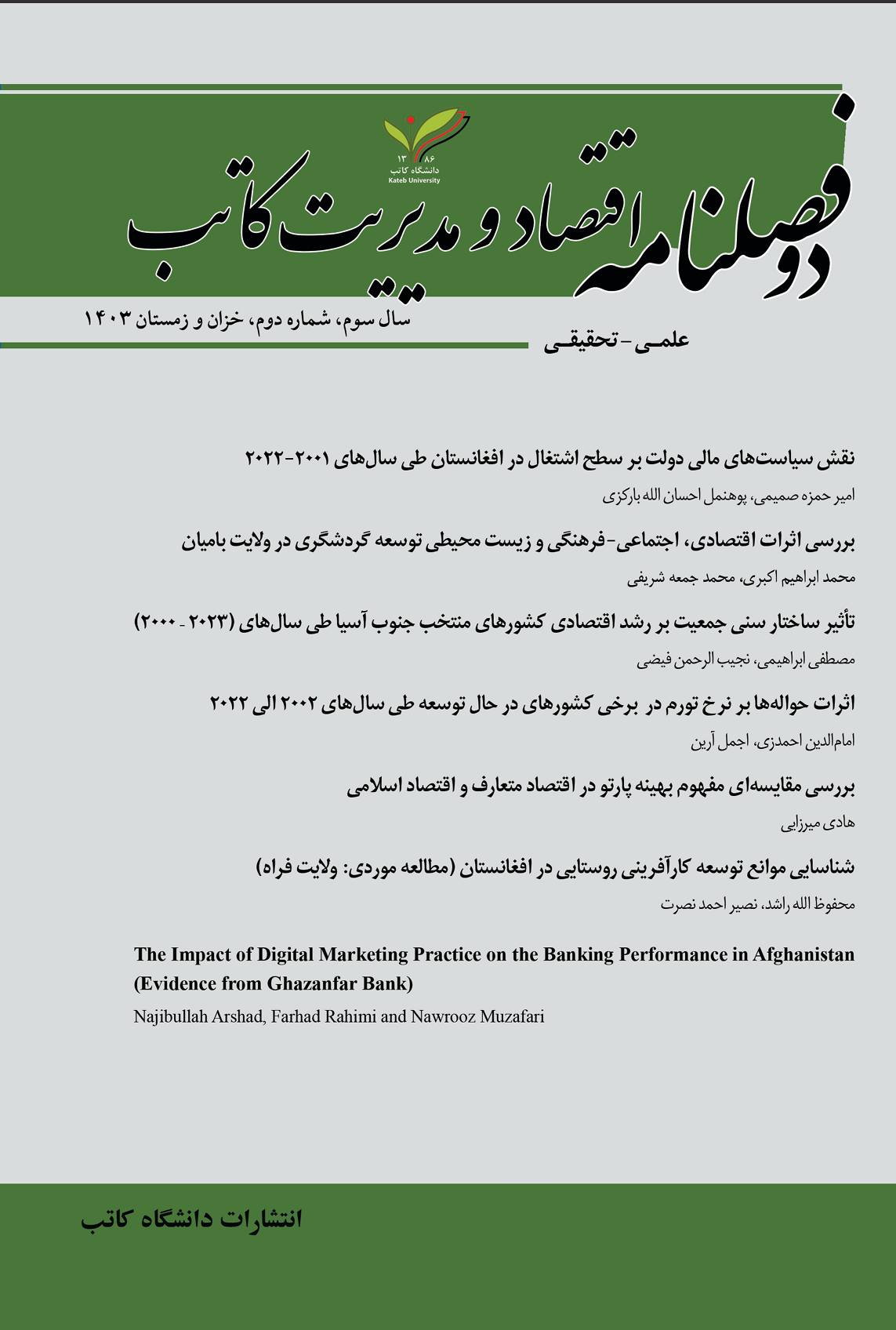
The Impact of Government Fiscal Policies on Employment Levels in Afghanistan (2001–2022)
Main Article Content
Abstract
Governments can influence economic conditions by employing various economic policies, among which fiscal policy plays a key role. Utilizing its two main instruments—taxation and government expenditure—fiscal policy enables governments to implement contractionary or expansionary measures to manage the economy. In times of recession, expansionary fiscal policy can serve as an effective tool to address economic challenges such as unemployment. This study aims to examine the impact of government fiscal policy on employment levels in Afghanistan during the period 2001 –2022. The research uses time series data collected from reliable sources such as the World Bank and the Ministry of Finance. Data analysis was conducted using a classical multiple regression model estimated through the Ordinary Least Squares (OLS) method in EViews software. Prior to model estimation, essential statistical tests for time series data—such as stationarity, normality, multicollinearity, autocorrelation, and homoscedasticity—were performed. The findings reveal that while fiscal policy contributed to employment growth in certain sectors—particularly construction and services—it did not have a statistically significant overall impact on employment levels throughout the studied period. Moreover, the effectiveness of fiscal policy has been constrained by challenges such as administrative corruption and inadequate infrastructure. The results of this research provide valuable insights for Afghan policymakers to improve fiscal policy implementation and promote sustainable employment and economic development in the country.
Keywords
Article Details
How to Cite
Similar Articles
- Najibullah Arshad, Ezatullah Karimi, Mohammad Akbar Rasuli, The Impact of Microfinance on the Performance of Small and Medium Enterprises in Kabul (A Case Study of District 13) , Kateb International Journal of Economics and Management: Vol. 4 No. 1 (1404): Vol. 4, No. 1, Spring & Summer 2025
- Imamuddin Ahmadzai, Ajmal Aryan, The Effects of Remittances on Inflation Rates in Selected Developing Countries (2002–2022) , Kateb International Journal of Economics and Management: Vol. 3 No. 2 (1403): Valume 3, Issue 2, Aumtumn 2024 & Winter 2025
- Mahfoozullah Rashid, Nasir Ahmad Nusrat, Identifying Barriers to Rural Entrepreneurship Development in Afghanistan (A Case Study: Farah Province) , Kateb International Journal of Economics and Management: Vol. 3 No. 2 (1403): Valume 3, Issue 2, Aumtumn 2024 & Winter 2025
- Abdul Zakir Nabil, Mohammad Hassan Hassani, Farhad Behrangi, The Impact of Interest Rate, Investment, Inflation and Consumption and on GDP of Selected SAARC Member Countries (India, Pakistan, Bangladesh and Sri Lanka) from 2001 to 2022 , Kateb International Journal of Economics and Management: Vol. 4 No. 1 (1404): Vol. 4, No. 1, Spring & Summer 2025
- Behroz Sarwary, Seyyed Taleb Alavi Alavi, Business Cycles and Their Determinants in Afghanistan's Economy: A Time Series Analysis (2008-2020) , Kateb International Journal of Economics and Management: Vol. 3 No. 1 (1403): Volume. 3, Issue. 1 , Spring & Summer 2024
- Abbas Ali Abounouri, Mohammad Ghafari Fard, Rahila Nazari, The Impact of Macroeconomic Variables on the Economic Growth of Afghanistan (ARDL Approach) , Kateb International Journal of Economics and Management: Vol. 1 No. 2 (1401): Volume 1, Issue 2, Autumn & Winter 2022-2023
- Nadir Shah Nadir, Ezatullah Karimi, The Impact of Consumer Price Index on Foreign Exchange Reserves of Afghanistan , Kateb International Journal of Economics and Management: Vol. 2 No. 1 (1402): Volume. 2, Issue. 1, Spring & Summer 2023
- Mustafa Ibrahimi, Abdul Wahid Mohammadi, Ghulam Ali Mohebi, The Impact of the Tourism Industry on Income Distribution in Selected Developing Countries during 2010-2020 , Kateb International Journal of Economics and Management: Vol. 2 No. 1 (1402): Volume. 2, Issue. 1, Spring & Summer 2023
- Mahdi Safdari, Seyed Nezamuddin Makiyan, M. Ibrahim Akbary, The Effect of exchange rate fluctuations on Afghanistan'seconomic growth: during the years 2009-2023 , Kateb International Journal of Economics and Management: Vol. 3 No. 1 (1403): Volume. 3, Issue. 1 , Spring & Summer 2024
- Baber Amini, Nadir Shah Nadir, Analyzing The Impact of Corporate Governance on Firm Performance a Case Study of New Kabul Bank , Kateb International Journal of Economics and Management: Vol. 4 No. 2 (1404): Vol. 4, No 2, Autumn & Winter 2025-2026
You may also start an advanced similarity search for this article.