
Article Sidebar
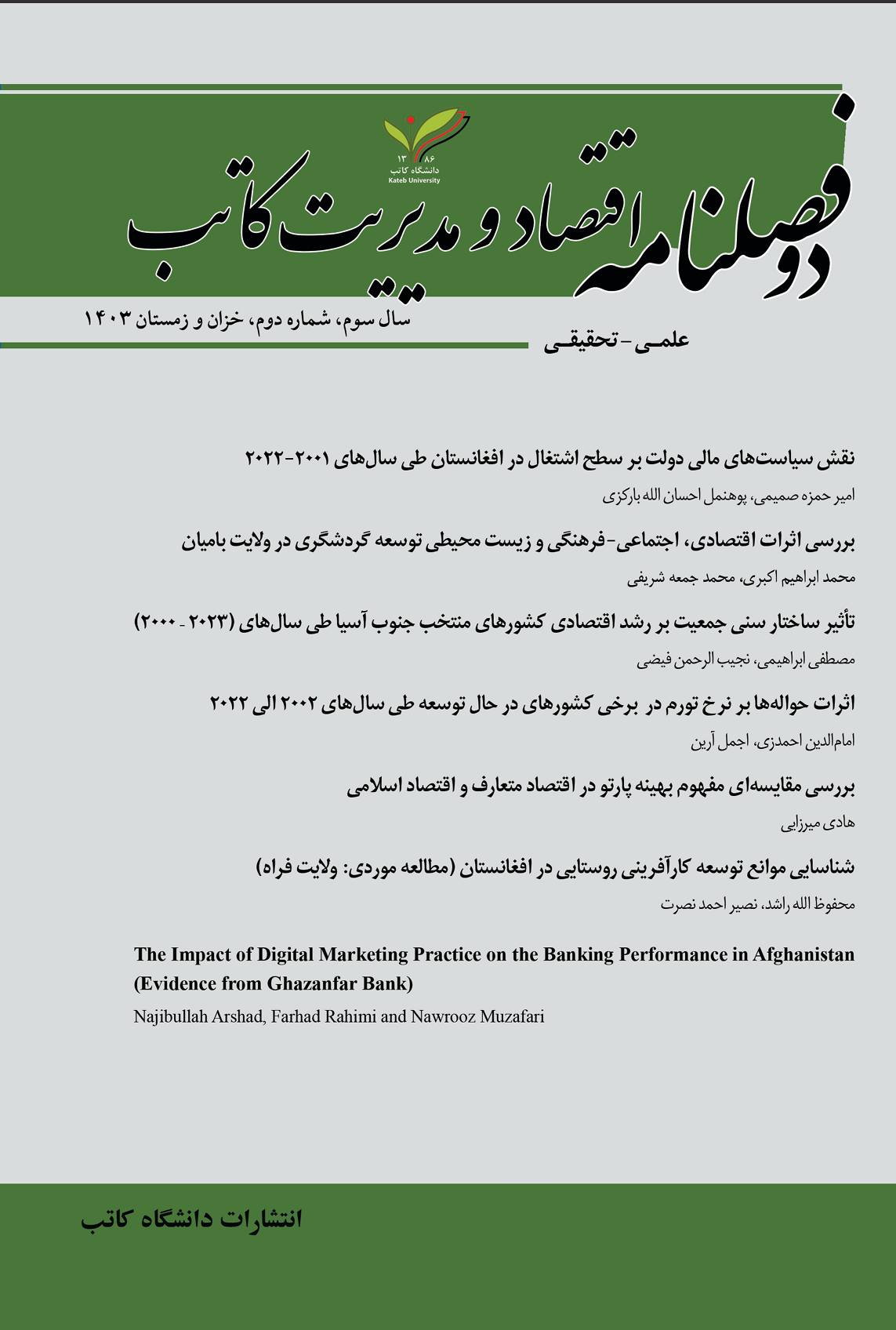
The Impact of Government Fiscal Policies on Employment Levels in Afghanistan (2001–2022)
Main Article Content
Abstract
Governments can influence economic conditions by employing various economic policies, among which fiscal policy plays a key role. Utilizing its two main instruments—taxation and government expenditure—fiscal policy enables governments to implement contractionary or expansionary measures to manage the economy. In times of recession, expansionary fiscal policy can serve as an effective tool to address economic challenges such as unemployment. This study aims to examine the impact of government fiscal policy on employment levels in Afghanistan during the period 2001 –2022. The research uses time series data collected from reliable sources such as the World Bank and the Ministry of Finance. Data analysis was conducted using a classical multiple regression model estimated through the Ordinary Least Squares (OLS) method in EViews software. Prior to model estimation, essential statistical tests for time series data—such as stationarity, normality, multicollinearity, autocorrelation, and homoscedasticity—were performed. The findings reveal that while fiscal policy contributed to employment growth in certain sectors—particularly construction and services—it did not have a statistically significant overall impact on employment levels throughout the studied period. Moreover, the effectiveness of fiscal policy has been constrained by challenges such as administrative corruption and inadequate infrastructure. The results of this research provide valuable insights for Afghan policymakers to improve fiscal policy implementation and promote sustainable employment and economic development in the country.
Keywords
Article Details
How to Cite
Similar Articles
- Mohammad Ibrahim Akbari, Mohammad Juma Sharifi, Analysis of the Economic, Socio-Cultural, and Environmental Impacts of Tourism Development in Bamyan Province , Kateb International Journal of Economics and Management: Vol. 3 No. 2 (1403): Valume 3, Issue 2, Aumtumn 2024 & Winter 2025
- Hassan Rohani, Najibullah Arshad, Hayatullah Sulaimankhail, Investigating the Impact of Good Governance on Inflation Rate in Selected Countries in the MENAP Region from 2006 to 2017 , Kateb International Journal of Economics and Management: Vol. 1 No. 1 (1401): Volume 1, Issue 1, Spring & Summer 2022
- Msustafa Ibrahimi, Najib Rahman Faizi, Analyzing the Impact of Age Structure on Economic Growth in Selected South Asian Countries from 2000 to 2023 , Kateb International Journal of Economics and Management: Vol. 3 No. 2 (1403): Valume 3, Issue 2, Aumtumn 2024 & Winter 2025
- Ahmad Samir Enami, Ajmal Arian, Assessing the Impact of Liquidity on Bank Profitability: A Comparative Study of Public and Private Banks in Afghanistan , Kateb International Journal of Economics and Management: Vol. 4 No. 1 (1404): Vol. 4, No. 1, Spring & Summer 2025
- Abdulaziz Azad, Sayed Abdulsamad Mushtaq , Ali Jan Rahimi, Abdulsalam Abed, Examining the Relationship Between Employee’s Job Satisfaction and Performance: A Case Study of Administrative Employees at Kabul Education University , Kateb International Journal of Economics and Management: Vol. 4 No. 1 (1404): Vol. 4, No. 1, Spring & Summer 2025
- Hadi Mirzaie, A Comparative Study of the Concept of Pareto Optimality in Conventional and Islamic Economics , Kateb International Journal of Economics and Management: Vol. 3 No. 2 (1403): Valume 3, Issue 2, Aumtumn 2024 & Winter 2025
- Mustafa Ibrahimi, Baharuddin Sahil, Examining the Impact of Entrepreneurship on Income Distribution Inequality in Selected South Asian Countries (2003–2023) , Kateb International Journal of Economics and Management: Vol. 4 No. 1 (1404): Vol. 4, No. 1, Spring & Summer 2025
- Najibullah Arshad, Farhad Rahimi, Nawrooz Muzafari, The Impact of Digital Marketing Practice on the Banking Performance in Afghanistan (Evidence from Ghazanfar Bank) , Kateb International Journal of Economics and Management: Vol. 3 No. 2 (1403): Valume 3, Issue 2, Aumtumn 2024 & Winter 2025
- Raziye Rezaie, Sediqa Rezaee, Investigating the Factors Affecting the Export of High Technology Product in emerging countries 2007-2017 , Kateb International Journal of Economics and Management: Vol. 1 No. 1 (1401): Volume 1, Issue 1, Spring & Summer 2022
- Mohammad Shah Sediq, Nahid Naderi Bani, Hossein Khanifar, Mohammad Miriae, University E-learning Model in Afghanistan , Kateb International Journal of Economics and Management: Vol. 1 No. 2 (1401): Volume 1, Issue 2, Autumn & Winter 2022-2023
You may also start an advanced similarity search for this article.