
Article Sidebar
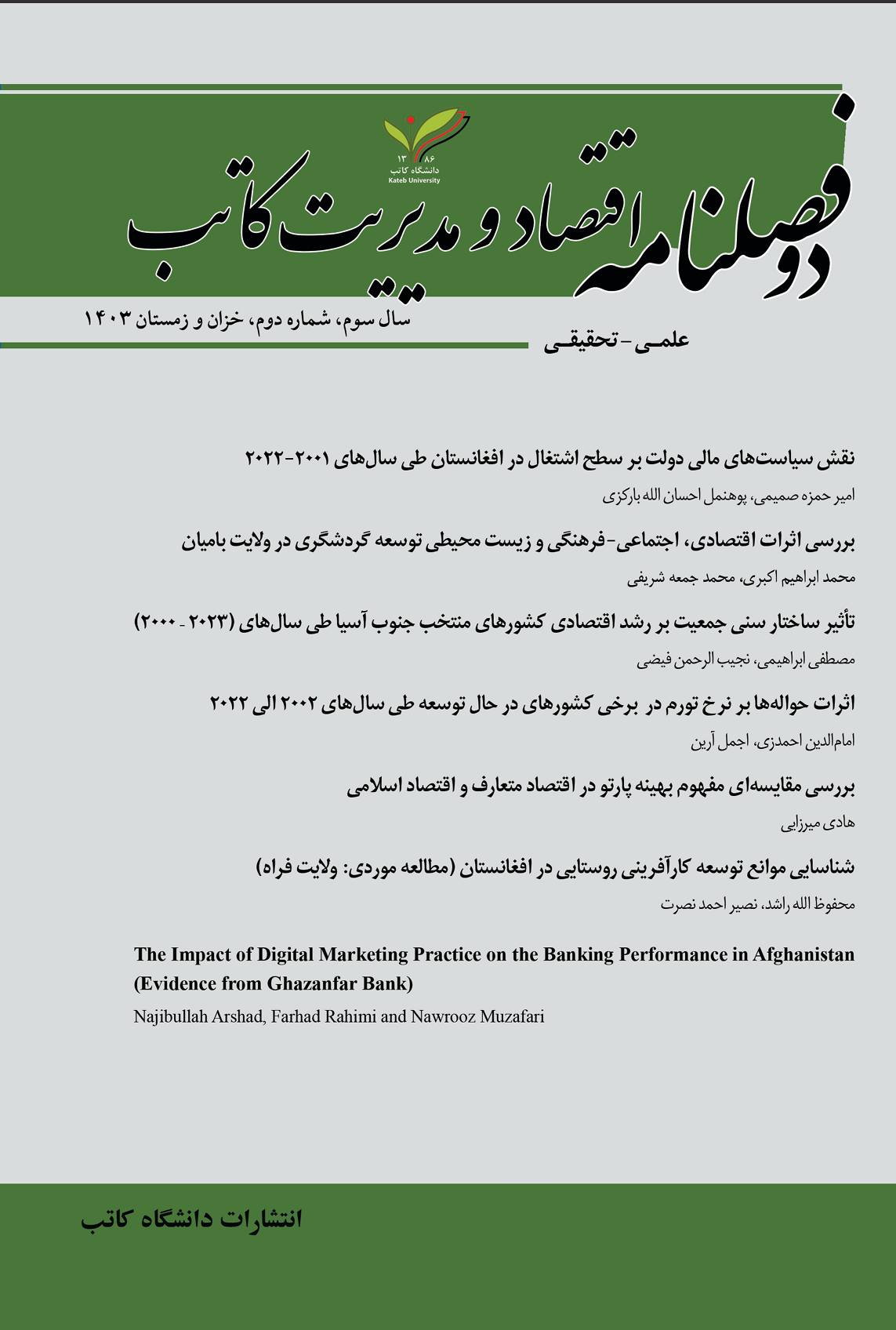
Identifying Barriers to Rural Entrepreneurship Development in Afghanistan (A Case Study: Farah Province)
Main Article Content
Abstract
Rural entrepreneurship is considered one of the fundamental strategies for poverty reduction, job creation, and achieving sustainable development in rural communities of developing countries. Afghanistan, despite significant potential in agriculture, natural resources, and a young workforce, still faces extensive challenges in developing entrepreneurship in rural areas. This research aims to identify the main obstacles to entrepreneurship development in Farah Province. The research method was qualitative, based on semistructured interviews conducted with 130 local entrepreneurs, tribal elders, government officials, students, teachers, and other informed individuals. Samples were selected purposefully, and data analysis was carried out using the qualitative content analysis method. The research findings indicate that rural entrepreneurship development in Farah Province faces a range of structural, economic, social, and institutional barriers. The most important of these obstacles include: lack of security and political stability, limited access to financial resources, severe weakness in infrastructure, absence of a clear support system, low levels of education and skills, cultural and social limitations, lack of stable markets, absence of entrepreneurship development centers, and legal and regulatory challenges. These obstacles are interconnected and have led to a reduction in motivation, opportunities, and economic growth capacity in rural communities. Based on the findings, the research emphasizes the necessity of adopting a multidimensional and coordinated approach among governmental, local, and private institutions to empower rural entrepreneurs. Establishing support centers, improving access to funding, reforming regulations, and strengthening the culture of entrepreneurship are among the key solutions proposed by this study.
Keywords
Article Details
How to Cite
Similar Articles
- Mohammad Rahim Ehsan, Ghulam Ali Mohibby, The Impact of Business Environment on Entrepreneurship: A Case Study of Selected Islamic Countries , Kateb International Journal of Economics and Management: Vol. 4 No. 1 (1404): Vol. 4, No. 1, Spring & Summer 2025
- Nawroaz Mozaffari, Mohammad Fahim Rahimi, Meta-Analysis of Factors Influencing Rural Entrepreneurship in Afghanistan , Kateb International Journal of Economics and Management: Vol. 4 No. 1 (1404): Vol. 4, No. 1, Spring & Summer 2025
- Mustafa Ibrahimi, Baharuddin Sahil, Examining the Impact of Entrepreneurship on Income Distribution Inequality in Selected South Asian Countries (2003–2023) , Kateb International Journal of Economics and Management: Vol. 4 No. 1 (1404): Vol. 4, No. 1, Spring & Summer 2025
- Dawood Yousofzai, Adela Rahmati, Poverty Reduction Strategies and Policy Programs in Afghanistan: A Qualitative Research Study , Kateb International Journal of Economics and Management: Vol. 4 No. 2 (1404): Vol. 4, No 2, Autumn & Winter 2025-2026
- Mohammad Ali Fahimi, The Impact of Knowledge-Based Human Resource Management with the Mediating Role of Intellectual Capital and Social Capital on Innovation in Afghan Manufacturing Companies , Kateb International Journal of Economics and Management: Vol. 2 No. 1 (1402): Volume. 2, Issue. 1, Spring & Summer 2023
- Zahir Safaei, Mahdi Hassani, Investigating the role of Entrepreneurship Education on the Entrepreneurial Intention of Students at Universities in Kabul City , Kateb International Journal of Economics and Management: Vol. 4 No. 2 (1404): Vol. 4, No 2, Autumn & Winter 2025-2026
- Mohammad Ibrahim Akbari, Mohammad Juma Sharifi, Analysis of the Economic, Socio-Cultural, and Environmental Impacts of Tourism Development in Bamyan Province , Kateb International Journal of Economics and Management: Vol. 3 No. 2 (1403): Valume 3, Issue 2, Aumtumn 2024 & Winter 2025
- Mustafa Ibrahimi, Mohammad Wahid Sarwari, The Impact of Foreign Direct Investment on Entrepreneurship in Selected East Asian Countries During the Period 2014–2024 , Kateb International Journal of Economics and Management: Vol. 4 No. 2 (1404): Vol. 4, No 2, Autumn & Winter 2025-2026
- Surajudin Fetrat, Mohammad Ehsan Erfani, The Impact of Population Growth on Poverty in Southeast Asian Countries (1393-1403) , Kateb International Journal of Economics and Management: Vol. 4 No. 1 (1404): Vol. 4, No. 1, Spring & Summer 2025
- Hadi Mirzaie, A Comparative Study of the Concept of Pareto Optimality in Conventional and Islamic Economics , Kateb International Journal of Economics and Management: Vol. 3 No. 2 (1403): Valume 3, Issue 2, Aumtumn 2024 & Winter 2025
You may also start an advanced similarity search for this article.