
Article Sidebar
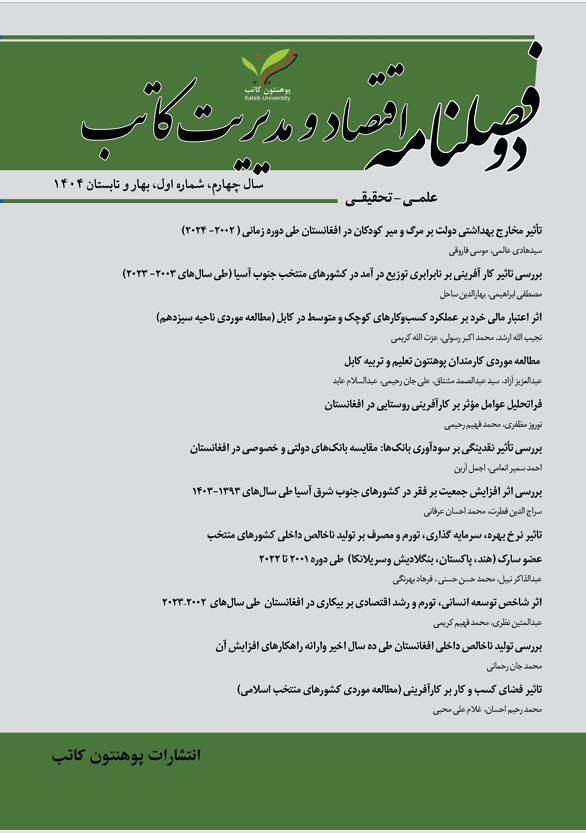
The Impact of Government Health Expenditures on Child Mortality in Afghanistan During the Years (2002–2024)
Main Article Content
Abstract
Child mortality is one of the major challenges within the human development index (HDI) framework, posing serious risks to the survival of children. Although the Government of Afghanistan and child-support organizations have implemented comprehensive programs and allocated financial resources to reduce child mortality, the child mortality rate in the country remains a subject of concern. The present study examines the impact of government expenditures on child mortality in Afghanistan during the period 2002–2024. This research employs the ordinary least squares (OLS) method. In the model used for this study, the child mortality rate (CMR) is considered a function of government per-capita health expenditures, per-capita gross domestic product, adult literacy rate, fertility rate, and urbanization rate. The findings of this study indicate that the effect of government health expenditures on child mortality in Afghanistan is negative and statistically significant. Specifically, an increase of one unit in per-capita government health expenditures leads to a decrease of 1.1217 units in the child mortality rate. Overall, the regression results show that several explanatory variables play an important role in explaining variations in the dependent variable. Among these variables, per-capita health expenditures, adult literacy rate, and urbanization rate have a negative and significant impact on the dependent variable. In contrast, the coefficients of women’s fertility rate and per-capita GDP are statistically insignificant; therefore, their definitive effects on the dependent variable cannot be asserted.
Keywords
Article Details
How to Cite
Similar Articles
- Abdulmatin Nazari, Mohammad Fahim Karimi, The Impact of the Human Development Index, Inflation, and Economic Growth on Unemployment in Afghanistan (2002–2023) , Kateb International Journal of Economics and Management: Vol. 4 No. 1 (1404): Vol. 4, No. 1, Spring & Summer 2025
- Nadir Shah Nadir, Ezatullah Karimi, The Impact of Consumer Price Index on Foreign Exchange Reserves of Afghanistan , Kateb International Journal of Economics and Management: Vol. 2 No. 1 (1402): Volume. 2, Issue. 1, Spring & Summer 2023
- Amir Hamza Samimi, Ehsanullah Barikzay, The Impact of Government Fiscal Policies on Employment Levels in Afghanistan (2001–2022) , Kateb International Journal of Economics and Management: Vol. 3 No. 2 (1403): Valume 3, Issue 2, Aumtumn 2024 & Winter 2025
- Mustafa Ibrahimi, Baharuddin Sahil, Examining the Impact of Entrepreneurship on Income Distribution Inequality in Selected South Asian Countries (2003–2023) , Kateb International Journal of Economics and Management: Vol. 4 No. 1 (1404): Vol. 4, No. 1, Spring & Summer 2025
- Mohammad Ghafari Far, Rahila Nazari, Evaluation of Health Indicators of Khalmezbank Islamic Bank of Afghanistan (Bakhtar Bank) Before and After its Conversion to Islamic Banking. , Kateb International Journal of Economics and Management: Vol. 1 No. 2 (1401): Volume 1, Issue 2, Autumn & Winter 2022-2023
- Mahfoozullah Rashid, Nasir Ahmad Nusrat, Identifying Barriers to Rural Entrepreneurship Development in Afghanistan (A Case Study: Farah Province) , Kateb International Journal of Economics and Management: Vol. 3 No. 2 (1403): Valume 3, Issue 2, Aumtumn 2024 & Winter 2025
- Hassan Rohani, Ahmad Mohammadi, Hamida Haidari, Review of the relative advantage of agricultural product exports from Afghanistan (2005–2018) , Kateb International Journal of Economics and Management: Vol. 1 No. 1 (1401): Volume 1, Issue 1, Spring & Summer 2022
- Mohammad Ali Fahimi, The Impact of Knowledge-Based Human Resource Management with the Mediating Role of Intellectual Capital and Social Capital on Innovation in Afghan Manufacturing Companies , Kateb International Journal of Economics and Management: Vol. 2 No. 1 (1402): Volume. 2, Issue. 1, Spring & Summer 2023
- Hassan Rohani, Najibullah Arshad, Hayatullah Sulaimankhail, Investigating the Impact of Good Governance on Inflation Rate in Selected Countries in the MENAP Region from 2006 to 2017 , Kateb International Journal of Economics and Management: Vol. 1 No. 1 (1401): Volume 1, Issue 1, Spring & Summer 2022
- Mohammad Shah Sediq, Nahid Naderi Bani, Hossein Khanifar, Mohammad Miriae, University E-learning Model in Afghanistan , Kateb International Journal of Economics and Management: Vol. 1 No. 2 (1401): Volume 1, Issue 2, Autumn & Winter 2022-2023
You may also start an advanced similarity search for this article.