
Article Sidebar
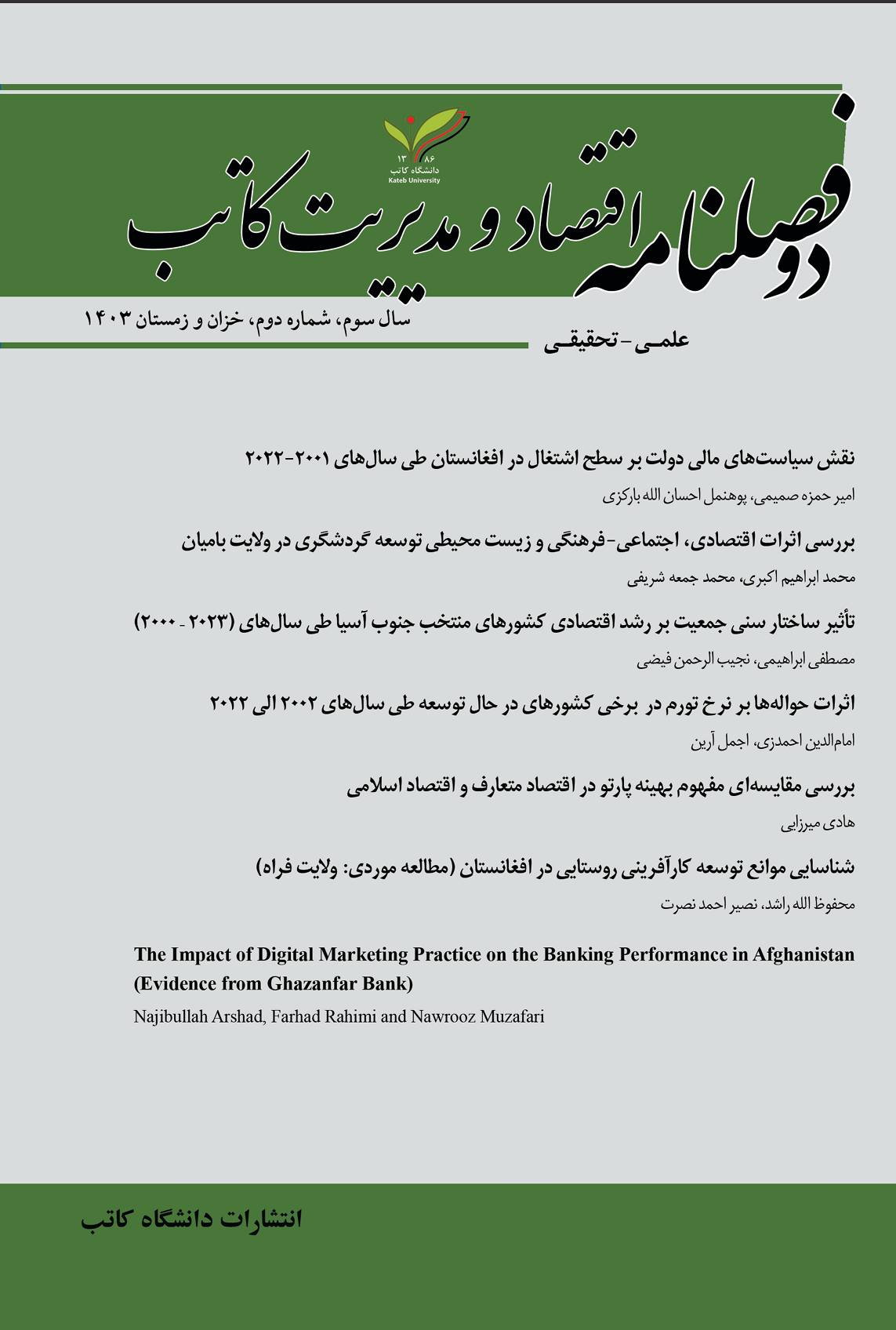
The Impact of Government Fiscal Policies on Employment Levels in Afghanistan (2001–2022)
Main Article Content
Abstract
Governments can influence economic conditions by employing various economic policies, among which fiscal policy plays a key role. Utilizing its two main instruments—taxation and government expenditure—fiscal policy enables governments to implement contractionary or expansionary measures to manage the economy. In times of recession, expansionary fiscal policy can serve as an effective tool to address economic challenges such as unemployment. This study aims to examine the impact of government fiscal policy on employment levels in Afghanistan during the period 2001 –2022. The research uses time series data collected from reliable sources such as the World Bank and the Ministry of Finance. Data analysis was conducted using a classical multiple regression model estimated through the Ordinary Least Squares (OLS) method in EViews software. Prior to model estimation, essential statistical tests for time series data—such as stationarity, normality, multicollinearity, autocorrelation, and homoscedasticity—were performed. The findings reveal that while fiscal policy contributed to employment growth in certain sectors—particularly construction and services—it did not have a statistically significant overall impact on employment levels throughout the studied period. Moreover, the effectiveness of fiscal policy has been constrained by challenges such as administrative corruption and inadequate infrastructure. The results of this research provide valuable insights for Afghan policymakers to improve fiscal policy implementation and promote sustainable employment and economic development in the country.
Keywords
Article Details
How to Cite
Similar Articles
- Sayed Hadi Alimi, Musa Farooqi, The Impact of Government Health Expenditures on Child Mortality in Afghanistan During the Years (2002–2024) , Kateb International Journal of Economics and Management: Vol. 4 No. 1 (1404): Vol. 4, No. 1, Spring & Summer 2025
- Mohammad GhafariFard, Seyed Taher Mosavi, Investigating the effect of financial policy on inflation with emphasis on government expenditures In Afghanistan in the period (1381-1395) , Kateb International Journal of Economics and Management: Vol. 1 No. 1 (1401): Volume 1, Issue 1, Spring & Summer 2022
- Dawood Yousofzai, Adela Rahmati, Income on the Impact of Monetary Policy Channels on Economic Variables Based on the Systemic Dynamic Approach , Kateb International Journal of Economics and Management: Vol. 1 No. 2 (1401): Volume 1, Issue 2, Autumn & Winter 2022-2023
- Mohammad Jan Rahmani, An Analysis of Afghanistan’s Gross Domestic Product Over the Past Decade and Policy Recommendations for Its Enhancement , Kateb International Journal of Economics and Management: Vol. 4 No. 1 (1404): Vol. 4, No. 1, Spring & Summer 2025
- Dawood Yousofzai, Adela Rahmati, Poverty Reduction Strategies and Policy Programs in Afghanistan: A Qualitative Research Study , Kateb International Journal of Economics and Management: Vol. 4 No. 2 (1404): Vol. 4, No 2, Autumn & Winter 2025-2026
- Mohammad Ebraim Askari, Investigating the Impact of Government Size on Gross Domestic Product in Afghanistan Using the Vector Regression (VAR) Model , Kateb International Journal of Economics and Management: Vol. 1 No. 1 (1401): Volume 1, Issue 1, Spring & Summer 2022
- Abdul Wahab Zaheer, Waheedullah Hemat, Murad Ali Ziarmal, Muhammad Osman Sharifi, An Empirical Analysis of Imports, Exports, Exchange Rate and Inflation as Determinants of Economic Growth in Afghanistan , Kateb International Journal of Economics and Management: Vol. 4 No. 2 (1404): Vol. 4, No 2, Autumn & Winter 2025-2026
- Dawood Yousofzai, Adela Rahmati, Asadullah Shayan Shayan, Modeling Causal Relationships of Government Revenues and Budget Deficits with a System Dynamics Approach , Kateb International Journal of Economics and Management: Vol. 3 No. 1 (1403): Volume. 3, Issue. 1 , Spring & Summer 2024
- Mohammad Ebrahim Akbari, The Impact of Government Size on Economic Growth: A Case Study of Selected G20 Countries , Kateb International Journal of Economics and Management: Vol. 2 No. 2 (1402): Volume. 2, Issue. 2, َAutumn & Winter 2023-2024
- Dawood Yousofzai, Adela Rahmati, Examination of Monetary and Fiscal Policies in the Islamic Economic System with a System Dynamics Approach , Kateb International Journal of Economics and Management: Vol. 2 No. 2 (1402): Volume. 2, Issue. 2, َAutumn & Winter 2023-2024
You may also start an advanced similarity search for this article.