
Article Sidebar
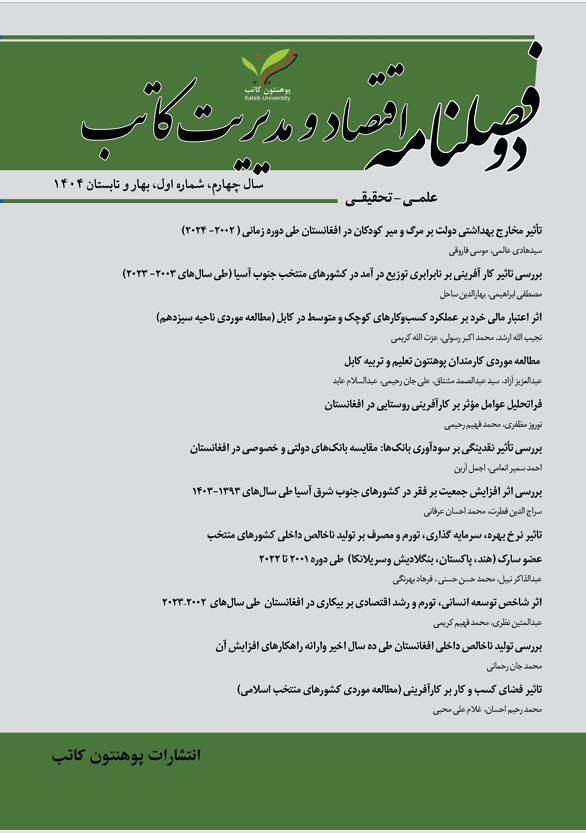
The Impact of Government Health Expenditures on Child Mortality in Afghanistan During the Years (2002–2024)
Main Article Content
Abstract
Child mortality is one of the major challenges within the human development index (HDI) framework, posing serious risks to the survival of children. Although the Government of Afghanistan and child-support organizations have implemented comprehensive programs and allocated financial resources to reduce child mortality, the child mortality rate in the country remains a subject of concern. The present study examines the impact of government expenditures on child mortality in Afghanistan during the period 2002–2024. This research employs the ordinary least squares (OLS) method. In the model used for this study, the child mortality rate (CMR) is considered a function of government per-capita health expenditures, per-capita gross domestic product, adult literacy rate, fertility rate, and urbanization rate. The findings of this study indicate that the effect of government health expenditures on child mortality in Afghanistan is negative and statistically significant. Specifically, an increase of one unit in per-capita government health expenditures leads to a decrease of 1.1217 units in the child mortality rate. Overall, the regression results show that several explanatory variables play an important role in explaining variations in the dependent variable. Among these variables, per-capita health expenditures, adult literacy rate, and urbanization rate have a negative and significant impact on the dependent variable. In contrast, the coefficients of women’s fertility rate and per-capita GDP are statistically insignificant; therefore, their definitive effects on the dependent variable cannot be asserted.
Keywords
Article Details
How to Cite
Similar Articles
- Mohammad Shah Sediq, Nahid Naderi Bani, Hossein Khanifar, Mohammad Miriae, University E-learning Model in Afghanistan , Kateb International Journal of Economics and Management: Vol. 1 No. 2 (1401): Volume 1, Issue 2, Autumn & Winter 2022-2023
- Nawroaz Mozaffari, Mohammad Fahim Rahimi, Meta-Analysis of Factors Influencing Rural Entrepreneurship in Afghanistan , Kateb International Journal of Economics and Management: Vol. 4 No. 1 (1404): Vol. 4, No. 1, Spring & Summer 2025
- Mohammad GhafariFard, Seyed Taher Mosavi, Investigating the effect of financial policy on inflation with emphasis on government expenditures In Afghanistan in the period (1381-1395) , Kateb International Journal of Economics and Management: Vol. 1 No. 1 (1401): Volume 1, Issue 1, Spring & Summer 2022
- Mohammad Rahim Ehsan, Ghulam Ali Mohibby, The Impact of Business Environment on Entrepreneurship: A Case Study of Selected Islamic Countries , Kateb International Journal of Economics and Management: Vol. 4 No. 1 (1404): Vol. 4, No. 1, Spring & Summer 2025
- Imamuddin Ahmadzai, Ajmal Aryan, The Effects of Remittances on Inflation Rates in Selected Developing Countries (2002–2022) , Kateb International Journal of Economics and Management: Vol. 3 No. 2 (1403): Valume 3, Issue 2, Aumtumn 2024 & Winter 2025
- Surajudin Fetrat, Mohammad Ehsan Erfani, The Impact of Population Growth on Poverty in Southeast Asian Countries (1393-1403) , Kateb International Journal of Economics and Management: Vol. 4 No. 1 (1404): Vol. 4, No. 1, Spring & Summer 2025
- Hadi Mirzaie, A Comparative Study of the Concept of Pareto Optimality in Conventional and Islamic Economics , Kateb International Journal of Economics and Management: Vol. 3 No. 2 (1403): Valume 3, Issue 2, Aumtumn 2024 & Winter 2025
- Msustafa Ibrahimi, Najib Rahman Faizi, Analyzing the Impact of Age Structure on Economic Growth in Selected South Asian Countries from 2000 to 2023 , Kateb International Journal of Economics and Management: Vol. 3 No. 2 (1403): Valume 3, Issue 2, Aumtumn 2024 & Winter 2025
- Najibullah Arshad, Mohib Hussain Laali, Abdullah Rasoli, Ghulam Abbas Alamdar, Factors Influencing Purchase Decisions and Brand Preferences of FMCG Consumers in Kabul , Kateb International Journal of Economics and Management: Vol. 4 No. 2 (1404): Vol. 4, No 2, Autumn & Winter 2025-2026
- Mohammad Ebraim Askari, Investigating the Impact of Government Size on Gross Domestic Product in Afghanistan Using the Vector Regression (VAR) Model , Kateb International Journal of Economics and Management: Vol. 1 No. 1 (1401): Volume 1, Issue 1, Spring & Summer 2022
You may also start an advanced similarity search for this article.