
Article Sidebar
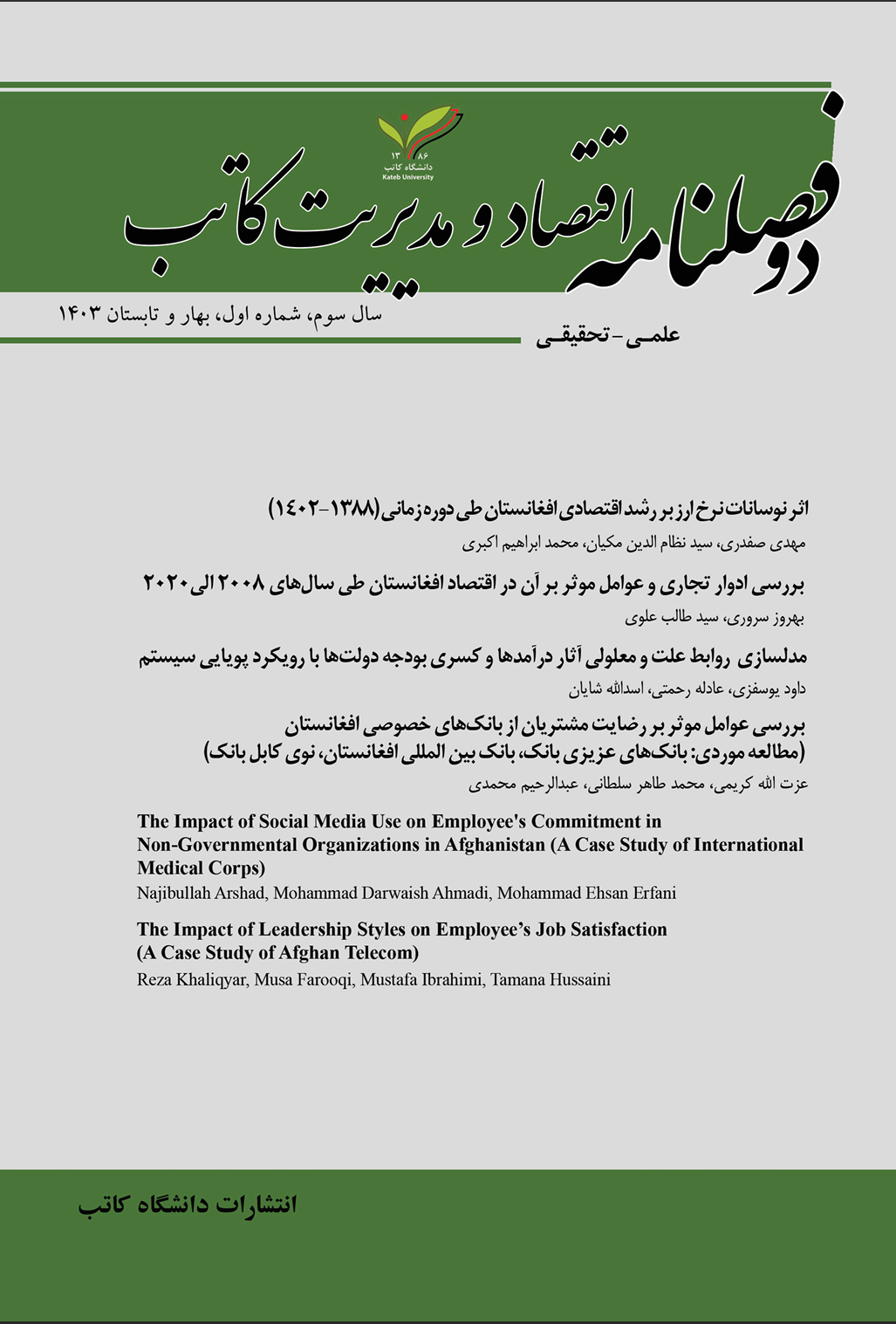
The Effect of exchange rate fluctuations on Afghanistan'seconomic growth: during the years 2009-2023
Main Article Content
Abstract
It is quite clear that the exchange rate is one of the essential variables in macroeconomics; hence its fluctuations affect other economic’ variables as well. The purpose of the current research is to comprehend the effect of exchange rate fluctuations on Afghanistan’s economic growth using the vector auto -regression (VAR) model, during the 2009-2023 years. The results of research obviously show that there is a negative and significant relationship between the exchange rate variable and the economic development. This is due to the relevancy of the country’s economy, the industrial, service and agricultural sectors to the import of raw material and inputs. On the other hand, there is a positive and significant relationship between the export variable, the formation of fixed gross domestic capital and economic growth, which means that the increase of exchange rate through strengthening exports and enlarging the investment capacities will cause the economic growth. According to the mentioned results, for the competitiveness of export goods in universal markets and for decreasing the economy’s dependency to imports, it is requested to utilize the strengthening import substitution strategy for the development of the country.
Keywords
Article Details
How to Cite
Similar Articles
- Dawood Yousofzai, Adela Rahmati, Income on the Impact of Monetary Policy Channels on Economic Variables Based on the Systemic Dynamic Approach , Kateb International Journal of Economics and Management: Vol. 1 No. 2 (1401): Volume 1, Issue 2, Autumn & Winter 2022-2023
- Mohammad Shah Sediq, Nahid Naderi Bani, Hossein Khanifar, Mohammad Miriae, University E-learning Model in Afghanistan , Kateb International Journal of Economics and Management: Vol. 1 No. 2 (1401): Volume 1, Issue 2, Autumn & Winter 2022-2023
- Najibullah Arshad, Farhad Behrangi, Nadir Shah Nadir, Investigating the Impact of Information and Communication Technology on the Business Environment in BRICS Countries from 2000 to 2020 , Kateb International Journal of Economics and Management: Vol. 2 No. 1 (1402): Volume. 2, Issue. 1, Spring & Summer 2023
- Khowaja Abdul Jawad Siddiqi, Bibi Deyana Hidayat, A Comparative Analysis of Islamic and Conventional Banking , Kateb International Journal of Economics and Management: Vol. 2 No. 2 (1402): Volume. 2, Issue. 2, َAutumn & Winter 2023-2024
- Mustafa Ibrahimi, Abdul Wahid Mohammadi, Ghulam Ali Mohebi, The Impact of the Tourism Industry on Income Distribution in Selected Developing Countries during 2010-2020 , Kateb International Journal of Economics and Management: Vol. 2 No. 1 (1402): Volume. 2, Issue. 1, Spring & Summer 2023
- Najibullah Arshad, Ahmadnawid Wahidi , Tamana Hussaini, The Relationship Between the Supervisory Role of Inspectors in the Supreme Audit Office and the Enhancement of Administrative Integrity in Afghanistan , Kateb International Journal of Economics and Management: Vol. 2 No. 2 (1402): Volume. 2, Issue. 2, َAutumn & Winter 2023-2024
You may also start an advanced similarity search for this article.