
Article Sidebar
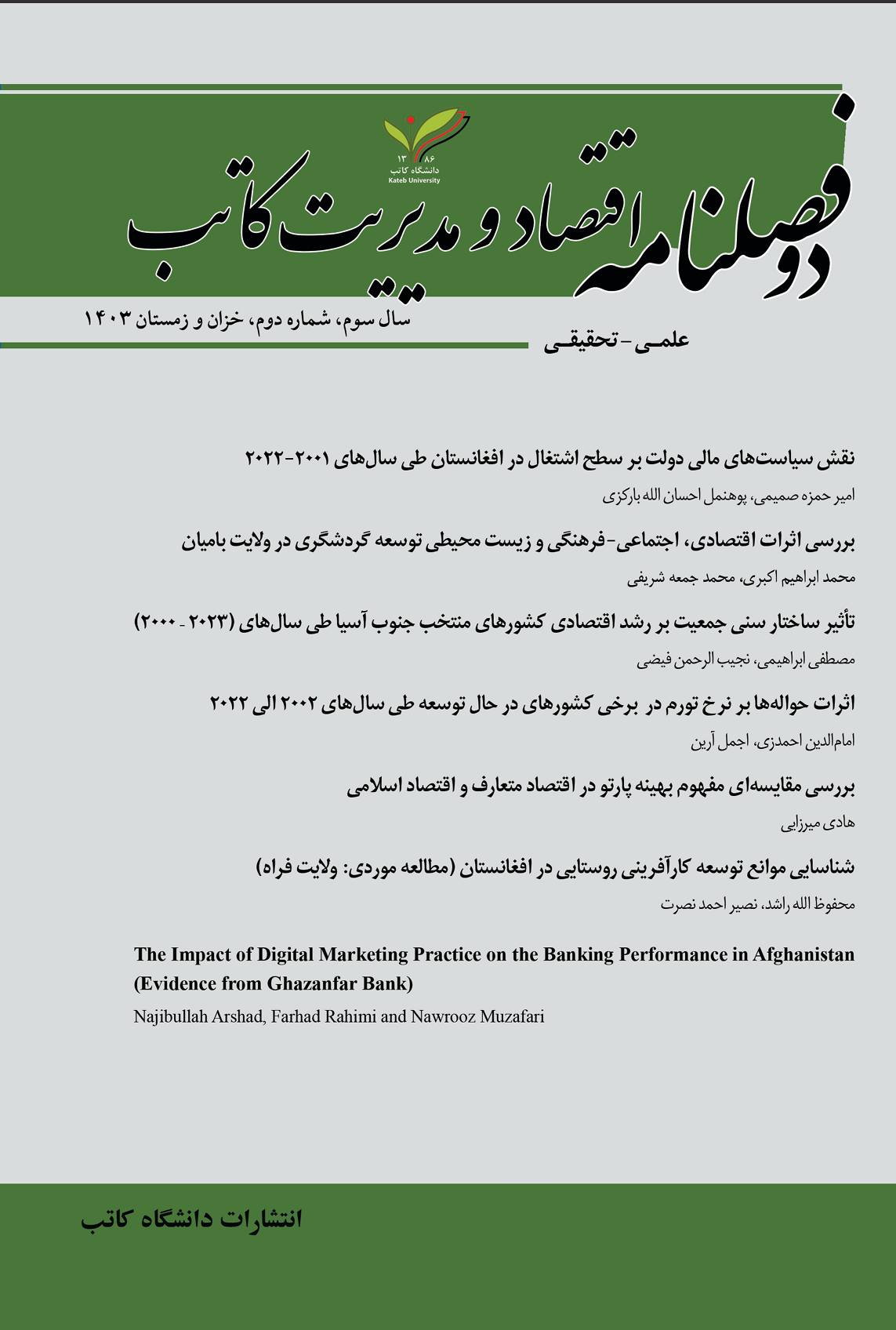
Analyzing the Impact of Age Structure on Economic Growth in Selected South Asian Countries from 2000 to 2023
Main Article Content
Abstract
Economic growth is one of the most important indicators of sustainable development in developing countries, particularly in the South Asian region. This study investigates the impact of population age structure on economic growth in selected South Asian countries during the period 2000–2023. To analyze this relationship accurately and avoid multicollinearity among explanatory variables, panel econometric models are employed in two separate specifications. Findings from the first model reveal that variables such as the working-age population, youth population, elderly population, and savings rate have a positive and statistically significant impact on economic growth. In contrast, school enrollment and trade openness exhibit a negative and significant effect. The second model confirms the positive and significant influence of variables including the working-age population, middle-aged population, old-age dependency ratio, trade openness, and savings rate on economic growth. The positive effect of the old-age dependency ratio in some countries may be attributed to factors such as elderly investment, economic participation, technological advancement, labor migration, and increased government spending. However, the negative and significant effect of school enrollment persists, potentially reflecting inefficiencies in education and trade policies or the short-term economic costs of schooling. The findings suggest that to effectively harness the region’s demographic and economic potential, policymakers should focus on improving education quality, expanding job opportunities for youth, developing economic infrastructure, enhancing labor productivity, and reforming trade policies.
Keywords
Article Details
How to Cite
Similar Articles
- Hassan Rohani, Ahmad Mohammadi, Hamida Haidari, Review of the relative advantage of agricultural product exports from Afghanistan (2005–2018) , Kateb International Journal of Economics and Management: Vol. 1 No. 1 (1401): Volume 1, Issue 1, Spring & Summer 2022
- Abbas Ali Abounouri, Mohammad Ghafari Fard, Rahila Nazari, The Impact of Macroeconomic Variables on the Economic Growth of Afghanistan (ARDL Approach) , Kateb International Journal of Economics and Management: Vol. 1 No. 2 (1401): Volume 1, Issue 2, Autumn & Winter 2022-2023
- Baber Amini, Nadir Shah Nadir, Analyzing The Impact of Corporate Governance on Firm Performance a Case Study of New Kabul Bank , Kateb International Journal of Economics and Management: Vol. 4 No. 2 (1404): Vol. 4, No 2, Autumn & Winter 2025-2026
- Mahdi Safdari, Seyed Nezamuddin Makiyan, M. Ibrahim Akbary, The Effect of exchange rate fluctuations on Afghanistan'seconomic growth: during the years 2009-2023 , Kateb International Journal of Economics and Management: Vol. 3 No. 1 (1403): Volume. 3, Issue. 1 , Spring & Summer 2024
- Najibullah Arshad, Farhad Behrangi, Nadir Shah Nadir, Investigating the Impact of Information and Communication Technology on the Business Environment in BRICS Countries from 2000 to 2020 , Kateb International Journal of Economics and Management: Vol. 2 No. 1 (1402): Volume. 2, Issue. 1, Spring & Summer 2023
- Mohammad Jan Rahmani, An Analysis of Afghanistan’s Gross Domestic Product Over the Past Decade and Policy Recommendations for Its Enhancement , Kateb International Journal of Economics and Management: Vol. 4 No. 1 (1404): Vol. 4, No. 1, Spring & Summer 2025
- Khowaja Abdul Jawad Siddiqi, Bibi Deyana Hidayat, A Comparative Analysis of Islamic and Conventional Banking , Kateb International Journal of Economics and Management: Vol. 2 No. 2 (1402): Volume. 2, Issue. 2, َAutumn & Winter 2023-2024
- Najibullah Arshad, Ahmadnawid Wahidi , Tamana Hussaini, The Relationship Between the Supervisory Role of Inspectors in the Supreme Audit Office and the Enhancement of Administrative Integrity in Afghanistan , Kateb International Journal of Economics and Management: Vol. 2 No. 2 (1402): Volume. 2, Issue. 2, َAutumn & Winter 2023-2024
- Najibullah Arshad, Ezatullah Karimi, Mohammad Akbar Rasuli, The Impact of Microfinance on the Performance of Small and Medium Enterprises in Kabul (A Case Study of District 13) , Kateb International Journal of Economics and Management: Vol. 4 No. 1 (1404): Vol. 4, No. 1, Spring & Summer 2025
- Hadi Mirzaie, A Comparative Study of the Concept of Pareto Optimality in Conventional and Islamic Economics , Kateb International Journal of Economics and Management: Vol. 3 No. 2 (1403): Valume 3, Issue 2, Aumtumn 2024 & Winter 2025
You may also start an advanced similarity search for this article.