
Article Sidebar
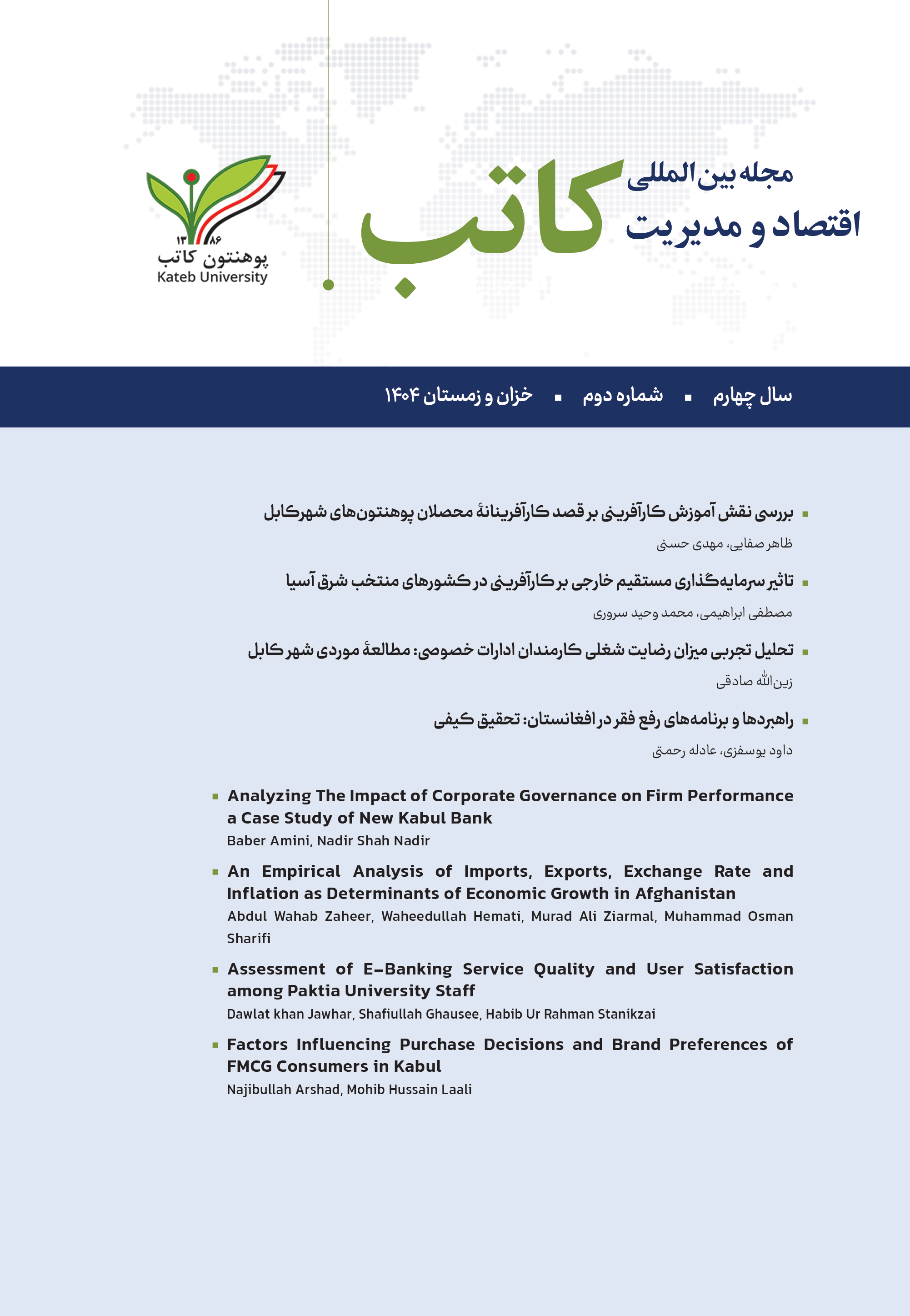
Poverty Reduction Strategies and Policy Programs in Afghanistan: A Qualitative Research Study
Main Article Content
Abstract
Poverty in Afghanistan is a multidimensional and structural phenomenon shaped by economic, institutional, social, and cultural factors. Despite the implementation of numerous relief and development programs, a significant portion of poverty reduction policies in the country has focused on short-term aid and income-based poverty measurement, with less attention paid to designing a comprehensive public policy framework. The main question of this research is what strategies and programs can be considered by policymakers for sustainable poverty reduction in Afghanistan. This qualitative study employs qualitative content analysis for data analysis. Data were collected through semi-structured interviews with 40 experts, including public managers, researchers, university academics, and policy practitioners in the fields of economics and public policy. Participants were selected through purposive sampling, and the interview process continued until theoretical saturation was reached. Data analysis was conducted based on initial coding, concept extraction, category formation, and identification of main themes. The findings identify three complementary policy pillars: regulatory policy, facilitative-supportive policy, and promotional policy. Regulatory policy emphasizes policy stability, administrative transparency, anti-corruption measures, a reliable legal system, and poverty-sensitive budgeting. Facilitative-supportive policy focuses on improving the business environment, directing credit to productive sectors, strengthening value chains, and expanding targeted social protection. Promotional policy highlights vocational education, economic literacy, work culture, community participation, and social capital. The research concludes that sustainable poverty reduction in Afghanistan requires synchronized institutional reforms, employment-oriented economic policies, and socio-cultural interventions. Without rebuilding public trust, strengthening local participation, and enhancing productive capacities, poverty alleviation programs are unlikely to achieve long-term impact. The proposed framework offers a context-sensitive roadmap for policymakers seeking integrated and sustainable poverty reduction strategies in fragile and developing economies.
Keywords
Article Details
How to Cite
Most read articles by the same author(s)
- Dawood Yousofzai, Adela Rahmati, Examination of Monetary and Fiscal Policies in the Islamic Economic System with a System Dynamics Approach , Kateb International Journal of Economics and Management: Vol. 2 No. 2 (1402): Volume. 2, Issue. 2, َAutumn & Winter 2023-2024
- Dawood Yousofzai, Adela Rahmati, Income on the Impact of Monetary Policy Channels on Economic Variables Based on the Systemic Dynamic Approach , Kateb International Journal of Economics and Management: Vol. 1 No. 2 (1401): Volume 1, Issue 2, Autumn & Winter 2022-2023
- Dawood Yousofzai, Adela Rahmati, Asadullah Shayan Shayan, Modeling Causal Relationships of Government Revenues and Budget Deficits with a System Dynamics Approach , Kateb International Journal of Economics and Management: Vol. 3 No. 1 (1403): Volume. 3, Issue. 1 , Spring & Summer 2024
Similar Articles
- Dawood Yousofzai, Adela Rahmati, Examination of Monetary and Fiscal Policies in the Islamic Economic System with a System Dynamics Approach , Kateb International Journal of Economics and Management: Vol. 2 No. 2 (1402): Volume. 2, Issue. 2, َAutumn & Winter 2023-2024
- Najibullah Arshad, Ahmadnawid Wahidi , Tamana Hussaini, The Relationship Between the Supervisory Role of Inspectors in the Supreme Audit Office and the Enhancement of Administrative Integrity in Afghanistan , Kateb International Journal of Economics and Management: Vol. 2 No. 2 (1402): Volume. 2, Issue. 2, َAutumn & Winter 2023-2024
- Abdul Zakir Nabil, Mohammad Hassan Hassani, Farhad Behrangi, The Impact of Interest Rate, Investment, Inflation and Consumption and on GDP of Selected SAARC Member Countries (India, Pakistan, Bangladesh and Sri Lanka) from 2001 to 2022 , Kateb International Journal of Economics and Management: Vol. 4 No. 1 (1404): Vol. 4, No. 1, Spring & Summer 2025
- Mohammad GhafariFard, Seyed Taher Mosavi, Investigating the effect of financial policy on inflation with emphasis on government expenditures In Afghanistan in the period (1381-1395) , Kateb International Journal of Economics and Management: Vol. 1 No. 1 (1401): Volume 1, Issue 1, Spring & Summer 2022
- Mustafa Ibrahimi, Mohammad Wahid Sarwari, The Impact of Foreign Direct Investment on Entrepreneurship in Selected East Asian Countries During the Period 2014–2024 , Kateb International Journal of Economics and Management: Vol. 4 No. 2 (1404): Vol. 4, No 2, Autumn & Winter 2025-2026
- Mohammad Rahim Ehsan, Ghulam Ali Mohibby, The Impact of Business Environment on Entrepreneurship: A Case Study of Selected Islamic Countries , Kateb International Journal of Economics and Management: Vol. 4 No. 1 (1404): Vol. 4, No. 1, Spring & Summer 2025
- Reza Khaliqyar, Mustafa Ibrahimi, Mustafa Ibrahimi, Tamana Hussaini, The Impact of Leadership Styles on Employee’s Job Satisfaction (A Case Study of Afghan Telecom) , Kateb International Journal of Economics and Management: Vol. 3 No. 1 (1403): Volume. 3, Issue. 1 , Spring & Summer 2024
- Abdulaziz Azad, Sayed Abdulsamad Mushtaq , Ali Jan Rahimi, Abdulsalam Abed, Examining the Relationship Between Employee’s Job Satisfaction and Performance: A Case Study of Administrative Employees at Kabul Education University , Kateb International Journal of Economics and Management: Vol. 4 No. 1 (1404): Vol. 4, No. 1, Spring & Summer 2025
- Khowaja Abdul Jawad Siddiqi, Bibi Deyana Hidayat, A Comparative Analysis of Islamic and Conventional Banking , Kateb International Journal of Economics and Management: Vol. 2 No. 2 (1402): Volume. 2, Issue. 2, َAutumn & Winter 2023-2024
- Abbas Ali Abounouri, Mohammad Ghafari Fard, Rahila Nazari, The Impact of Macroeconomic Variables on the Economic Growth of Afghanistan (ARDL Approach) , Kateb International Journal of Economics and Management: Vol. 1 No. 2 (1401): Volume 1, Issue 2, Autumn & Winter 2022-2023
You may also start an advanced similarity search for this article.