
Article Sidebar
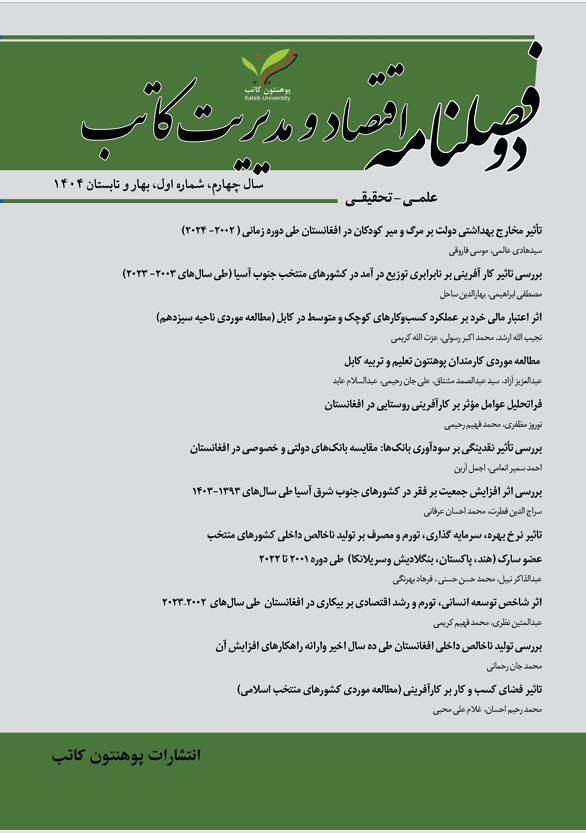
The Impact of Population Growth on Poverty in Southeast Asian Countries (1393-1403)
Main Article Content
Abstract
Poverty is one of the most significant development challenges in Southeast Asian countries, deeply intertwined with social, economic, and human structures. This phenomenon not only reflects income inequality and weaknesses in social support systems but also constitutes a serious barrier to sustainable growth and social justice. The present study aims to examine the impact of population growth on poverty in Southeast Asian countries during the period 1393–1403. The research employs the Generalized Least Squares (GLS) method, using panel data regression models to analyze the relationships among variables. The data were extracted from international statistical sources and analyzed using EViews software. The results indicate that the health variable, with a coefficient of −1.571792 and a significance level of 0.0190, has a negative and significant effect on poverty, implying that improvements in health indicators and equitable access to healthcare services contribute to poverty reduction. Additionally, the education variable, with a coefficient of −0.287840 and a significance level of 0.0740, exhibits a negative and moderately significant effect, highlighting the role of educational investment in poverty alleviation. In contrast, population growth, with a coefficient of 0.991023 and a significance level of 0.0239, has a positive and significant effect on poverty, indicating that an increasing population exerts pressure on economic resources and exacerbates inequality. The findings suggest that coordinated health, education, and population policies can play an effective role in reducing poverty and enhancing welfare in Southeast Asian countries.
Keywords
Article Details
How to Cite
Most read articles by the same author(s)
- Najibullah Arshad, Shams Al Rahman Samadi , Mohammad Ehsan Erfani, The Impact of Exchange Rate Volatility on Economic Growth and Inflation in SAARC Member Countries: A Study of 2002-2020 , Kateb International Journal of Economics and Management: Vol. 2 No. 2 (1402): Volume. 2, Issue. 2, َAutumn & Winter 2023-2024
- Najibullah Arshad, Mohammad Darwaish Ahmadi, Mohammad Ehsan Erfani, The Impact of Social Media Use on Employee's Commitment in Non-Governmental Organizations in Afghanistan (A Case Study of International Medical Corps) , Kateb International Journal of Economics and Management: Vol. 3 No. 1 (1403): Volume. 3, Issue. 1 , Spring & Summer 2024
Similar Articles
- Sayed Hadi Alimi, Musa Farooqi, The Impact of Government Health Expenditures on Child Mortality in Afghanistan During the Years (2002–2024) , Kateb International Journal of Economics and Management: Vol. 4 No. 1 (1404): Vol. 4, No. 1, Spring & Summer 2025
- Mahdi Safdari, Seyed Nezamuddin Makiyan, M. Ibrahim Akbary, The Effect of exchange rate fluctuations on Afghanistan'seconomic growth: during the years 2009-2023 , Kateb International Journal of Economics and Management: Vol. 3 No. 1 (1403): Volume. 3, Issue. 1 , Spring & Summer 2024
- Mohammad Jan Rahmani, An Analysis of Afghanistan’s Gross Domestic Product Over the Past Decade and Policy Recommendations for Its Enhancement , Kateb International Journal of Economics and Management: Vol. 4 No. 1 (1404): Vol. 4, No. 1, Spring & Summer 2025
- Hassan Rohani, Najibullah Arshad, Hayatullah Sulaimankhail, Investigating the Impact of Good Governance on Inflation Rate in Selected Countries in the MENAP Region from 2006 to 2017 , Kateb International Journal of Economics and Management: Vol. 1 No. 1 (1401): Volume 1, Issue 1, Spring & Summer 2022
- Dawood Yousofzai, Adela Rahmati, Income on the Impact of Monetary Policy Channels on Economic Variables Based on the Systemic Dynamic Approach , Kateb International Journal of Economics and Management: Vol. 1 No. 2 (1401): Volume 1, Issue 2, Autumn & Winter 2022-2023
- Hadi Mirzaie, A Comparative Study of the Concept of Pareto Optimality in Conventional and Islamic Economics , Kateb International Journal of Economics and Management: Vol. 3 No. 2 (1403): Valume 3, Issue 2, Aumtumn 2024 & Winter 2025
- Amir Hamza Samimi, Ehsanullah Barikzay, The Impact of Government Fiscal Policies on Employment Levels in Afghanistan (2001–2022) , Kateb International Journal of Economics and Management: Vol. 3 No. 2 (1403): Valume 3, Issue 2, Aumtumn 2024 & Winter 2025
- Najibullah Arshad, Mohammad Darwaish Ahmadi, Mohammad Ehsan Erfani, The Impact of Social Media Use on Employee's Commitment in Non-Governmental Organizations in Afghanistan (A Case Study of International Medical Corps) , Kateb International Journal of Economics and Management: Vol. 3 No. 1 (1403): Volume. 3, Issue. 1 , Spring & Summer 2024
- Najibullah Arshad, Ezatullah Karimi, Mohammad Akbar Rasuli, The Impact of Microfinance on the Performance of Small and Medium Enterprises in Kabul (A Case Study of District 13) , Kateb International Journal of Economics and Management: Vol. 4 No. 1 (1404): Vol. 4, No. 1, Spring & Summer 2025
You may also start an advanced similarity search for this article.