
Article Sidebar
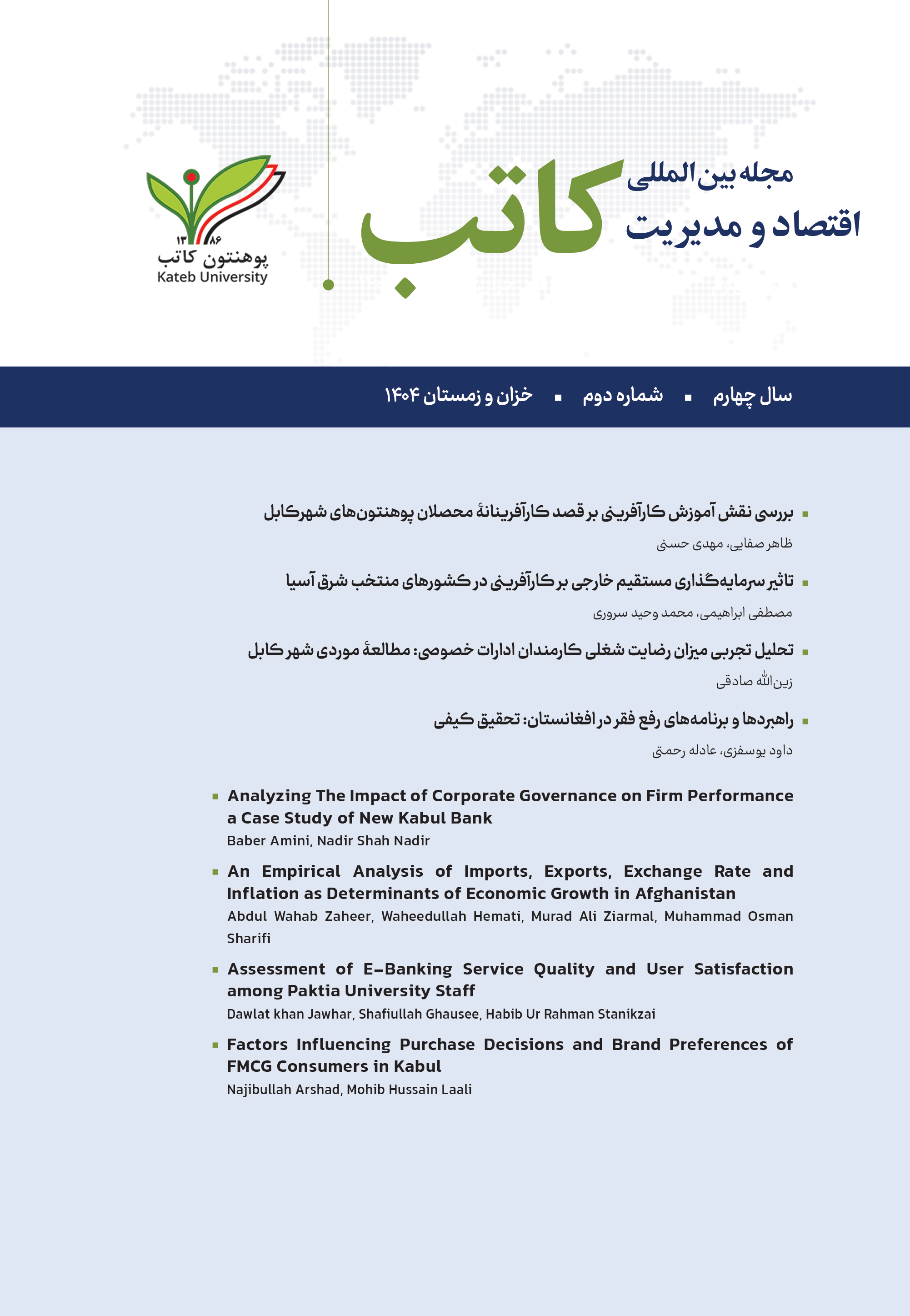
Poverty Reduction Strategies and Policy Programs in Afghanistan: A Qualitative Research Study
Main Article Content
Abstract
Poverty in Afghanistan is a multidimensional and structural phenomenon shaped by economic, institutional, social, and cultural factors. Despite the implementation of numerous relief and development programs, a significant portion of poverty reduction policies in the country has focused on short-term aid and income-based poverty measurement, with less attention paid to designing a comprehensive public policy framework. The main question of this research is what strategies and programs can be considered by policymakers for sustainable poverty reduction in Afghanistan. This qualitative study employs qualitative content analysis for data analysis. Data were collected through semi-structured interviews with 40 experts, including public managers, researchers, university academics, and policy practitioners in the fields of economics and public policy. Participants were selected through purposive sampling, and the interview process continued until theoretical saturation was reached. Data analysis was conducted based on initial coding, concept extraction, category formation, and identification of main themes. The findings identify three complementary policy pillars: regulatory policy, facilitative-supportive policy, and promotional policy. Regulatory policy emphasizes policy stability, administrative transparency, anti-corruption measures, a reliable legal system, and poverty-sensitive budgeting. Facilitative-supportive policy focuses on improving the business environment, directing credit to productive sectors, strengthening value chains, and expanding targeted social protection. Promotional policy highlights vocational education, economic literacy, work culture, community participation, and social capital. The research concludes that sustainable poverty reduction in Afghanistan requires synchronized institutional reforms, employment-oriented economic policies, and socio-cultural interventions. Without rebuilding public trust, strengthening local participation, and enhancing productive capacities, poverty alleviation programs are unlikely to achieve long-term impact. The proposed framework offers a context-sensitive roadmap for policymakers seeking integrated and sustainable poverty reduction strategies in fragile and developing economies.
Keywords
Article Details
How to Cite
Most read articles by the same author(s)
- Dawood Yousofzai, Adela Rahmati, Examination of Monetary and Fiscal Policies in the Islamic Economic System with a System Dynamics Approach , Kateb International Journal of Economics and Management: Vol. 2 No. 2 (1402): Volume. 2, Issue. 2, َAutumn & Winter 2023-2024
- Dawood Yousofzai, Adela Rahmati, Income on the Impact of Monetary Policy Channels on Economic Variables Based on the Systemic Dynamic Approach , Kateb International Journal of Economics and Management: Vol. 1 No. 2 (1401): Volume 1, Issue 2, Autumn & Winter 2022-2023
- Dawood Yousofzai, Adela Rahmati, Asadullah Shayan Shayan, Modeling Causal Relationships of Government Revenues and Budget Deficits with a System Dynamics Approach , Kateb International Journal of Economics and Management: Vol. 3 No. 1 (1403): Volume. 3, Issue. 1 , Spring & Summer 2024
Similar Articles
- Mohammad Ebraim Askari, Investigating the Impact of Government Size on Gross Domestic Product in Afghanistan Using the Vector Regression (VAR) Model , Kateb International Journal of Economics and Management: Vol. 1 No. 1 (1401): Volume 1, Issue 1, Spring & Summer 2022
- Mustafa Ibrahimi, Abdul Wahid Mohammadi, Ghulam Ali Mohebi, The Impact of the Tourism Industry on Income Distribution in Selected Developing Countries during 2010-2020 , Kateb International Journal of Economics and Management: Vol. 2 No. 1 (1402): Volume. 2, Issue. 1, Spring & Summer 2023
- Ahmad Samir Enami, Ajmal Arian, Assessing the Impact of Liquidity on Bank Profitability: A Comparative Study of Public and Private Banks in Afghanistan , Kateb International Journal of Economics and Management: Vol. 4 No. 1 (1404): Vol. 4, No. 1, Spring & Summer 2025
- Mohammad Ali Fahimi, The Impact of Knowledge-Based Human Resource Management with the Mediating Role of Intellectual Capital and Social Capital on Innovation in Afghan Manufacturing Companies , Kateb International Journal of Economics and Management: Vol. 2 No. 1 (1402): Volume. 2, Issue. 1, Spring & Summer 2023
- Najibullah Arshad, Idris Ahmadi, The Impact of Information and Communication Technology on the Exports and Imports of BRICS Member Countries During the Years 2000 to 2020. , Kateb International Journal of Economics and Management: Vol. 1 No. 2 (1401): Volume 1, Issue 2, Autumn & Winter 2022-2023
- Najibullah Arshad, Farhad Behrangi, Nadir Shah Nadir, Investigating the Impact of Information and Communication Technology on the Business Environment in BRICS Countries from 2000 to 2020 , Kateb International Journal of Economics and Management: Vol. 2 No. 1 (1402): Volume. 2, Issue. 1, Spring & Summer 2023
- Ezatullah Kakimi, Mohammad Taher Sultani, Abdul Rahim Mohammadi, Factors Affecting Customer Satisfaction in Private Banks of Afghanistan: A Case Study of Azizi Bank, Afghanistan International Bank, and New Kabul Bank , Kateb International Journal of Economics and Management: Vol. 3 No. 1 (1403): Volume. 3, Issue. 1 , Spring & Summer 2024
- Baber Amini, Nadir Shah Nadir, Analyzing The Impact of Corporate Governance on Firm Performance a Case Study of New Kabul Bank , Kateb International Journal of Economics and Management: Vol. 4 No. 2 (1404): Vol. 4, No 2, Autumn & Winter 2025-2026
- Dawlat khan Jawhar, Shafiullah Ghausee, Habib Ur Rahman Stanikzai, Assessment of E-Banking Service Quality and User Satisfaction among Paktia University Staff , Kateb International Journal of Economics and Management: Vol. 4 No. 2 (1404): Vol. 4, No 2, Autumn & Winter 2025-2026
- Hassan Rohani, Najibullah Arshad, Hayatullah Sulaimankhail, Investigating the Impact of Good Governance on Inflation Rate in Selected Countries in the MENAP Region from 2006 to 2017 , Kateb International Journal of Economics and Management: Vol. 1 No. 1 (1401): Volume 1, Issue 1, Spring & Summer 2022
You may also start an advanced similarity search for this article.