
Article Sidebar
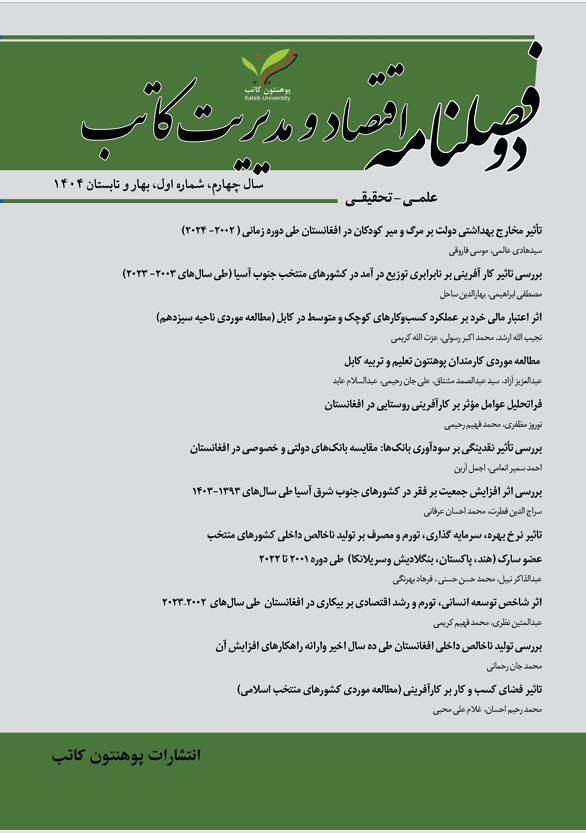
Meta-Analysis of Factors Influencing Rural Entrepreneurship in Afghanistan
Main Article Content
Abstract
One of the fundamental concepts in conventional economic theories is "Pareto efficiency," which is recognized as a criterion for economic efficiency in resource allocation. This criterion is based on the principle of increasing individual utility without decreasing the utility of others and holds a special place in classical economic analyses. However, criticisms have been leveled against this criterion by justice-oriented schools of thought, especially Islamic economics. The present study, with a comparative approach, analyzes the conceptual and evaluative aspects of Pareto efficiency from the perspectives of Islamic economics and conventional economics. The research methodology in this study is descriptive-analytical, and data was collected through documentary methods using valid scientific sources. The findings indicate that while conventional economics seeks allocative efficiency within a free market framework, Islamic economics emphasizes the integration of justice, efficiency, and Sharia legitimacy. In fact, Islamic economics replaces the purely technical concept of Pareto optimality with "ethical optimization." Furthermore, an examination of modern global economic theories such as sustainable development and human well-being reveals a growing tendency towards justice-oriented models, which aligns with the foundations of Islamic economics. Consequently, a re-evaluation of the concept of economic optimization and the presentation of an integrated Islamic-human-centered model can be an effective step towards justice-oriented economic development in the contemporary world.
Keywords
Article Details
How to Cite
Similar Articles
- Abbas Ali Abounouri, Mohammad Ghafari Fard, Rahila Nazari, The Impact of Macroeconomic Variables on the Economic Growth of Afghanistan (ARDL Approach) , Kateb International Journal of Economics and Management: Vol. 1 No. 2 (1401): Volume 1, Issue 2, Autumn & Winter 2022-2023
- Hassan Rohani, Ahmad Mohammadi, Hamida Haidari, Review of the relative advantage of agricultural product exports from Afghanistan (2005–2018) , Kateb International Journal of Economics and Management: Vol. 1 No. 1 (1401): Volume 1, Issue 1, Spring & Summer 2022
- Mohammad Hakim Haider, Determinants of Vulnerability to Poverty in Afghanistan , Kateb International Journal of Economics and Management: Vol. 2 No. 1 (1402): Volume. 2, Issue. 1, Spring & Summer 2023
- Mustafa Ibrahimi, Abdul Wahid Mohammadi, Ghulam Ali Mohebi, The Impact of the Tourism Industry on Income Distribution in Selected Developing Countries during 2010-2020 , Kateb International Journal of Economics and Management: Vol. 2 No. 1 (1402): Volume. 2, Issue. 1, Spring & Summer 2023
- Sayed Hadi Alimi, Musa Farooqi, The Impact of Government Health Expenditures on Child Mortality in Afghanistan During the Years (2002–2024) , Kateb International Journal of Economics and Management: Vol. 4 No. 1 (1404): Vol. 4, No. 1, Spring & Summer 2025
- Ezatullah Kakimi, Mohammad Taher Sultani, Abdul Rahim Mohammadi, Factors Affecting Customer Satisfaction in Private Banks of Afghanistan: A Case Study of Azizi Bank, Afghanistan International Bank, and New Kabul Bank , Kateb International Journal of Economics and Management: Vol. 3 No. 1 (1403): Volume. 3, Issue. 1 , Spring & Summer 2024
- Mohammad GhafariFard, Seyed Taher Mosavi, Investigating the effect of financial policy on inflation with emphasis on government expenditures In Afghanistan in the period (1381-1395) , Kateb International Journal of Economics and Management: Vol. 1 No. 1 (1401): Volume 1, Issue 1, Spring & Summer 2022
- Ahmad Samir Enami, Ajmal Arian, Assessing the Impact of Liquidity on Bank Profitability: A Comparative Study of Public and Private Banks in Afghanistan , Kateb International Journal of Economics and Management: Vol. 4 No. 1 (1404): Vol. 4, No. 1, Spring & Summer 2025
- Nadir Shah Nadir, Ezatullah Karimi, The Impact of Consumer Price Index on Foreign Exchange Reserves of Afghanistan , Kateb International Journal of Economics and Management: Vol. 2 No. 1 (1402): Volume. 2, Issue. 1, Spring & Summer 2023
- Najibullah Arshad, Mohammad Darwaish Ahmadi, Mohammad Ehsan Erfani, The Impact of Social Media Use on Employee's Commitment in Non-Governmental Organizations in Afghanistan (A Case Study of International Medical Corps) , Kateb International Journal of Economics and Management: Vol. 3 No. 1 (1403): Volume. 3, Issue. 1 , Spring & Summer 2024
You may also start an advanced similarity search for this article.