
Article Sidebar
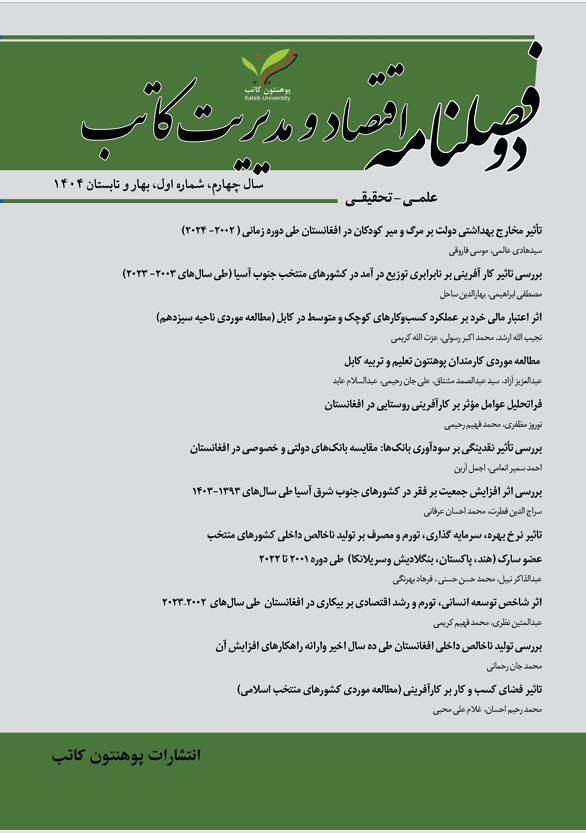
Meta-Analysis of Factors Influencing Rural Entrepreneurship in Afghanistan
Main Article Content
Abstract
One of the fundamental concepts in conventional economic theories is "Pareto efficiency," which is recognized as a criterion for economic efficiency in resource allocation. This criterion is based on the principle of increasing individual utility without decreasing the utility of others and holds a special place in classical economic analyses. However, criticisms have been leveled against this criterion by justice-oriented schools of thought, especially Islamic economics. The present study, with a comparative approach, analyzes the conceptual and evaluative aspects of Pareto efficiency from the perspectives of Islamic economics and conventional economics. The research methodology in this study is descriptive-analytical, and data was collected through documentary methods using valid scientific sources. The findings indicate that while conventional economics seeks allocative efficiency within a free market framework, Islamic economics emphasizes the integration of justice, efficiency, and Sharia legitimacy. In fact, Islamic economics replaces the purely technical concept of Pareto optimality with "ethical optimization." Furthermore, an examination of modern global economic theories such as sustainable development and human well-being reveals a growing tendency towards justice-oriented models, which aligns with the foundations of Islamic economics. Consequently, a re-evaluation of the concept of economic optimization and the presentation of an integrated Islamic-human-centered model can be an effective step towards justice-oriented economic development in the contemporary world.
Keywords
Article Details
How to Cite
Similar Articles
- Najibullah Arshad, Shams Al Rahman Samadi , Mohammad Ehsan Erfani, The Impact of Exchange Rate Volatility on Economic Growth and Inflation in SAARC Member Countries: A Study of 2002-2020 , Kateb International Journal of Economics and Management: Vol. 2 No. 2 (1402): Volume. 2, Issue. 2, َAutumn & Winter 2023-2024
- Mohammad Ibrahim Akbari, Mohammad Juma Sharifi, Analysis of the Economic, Socio-Cultural, and Environmental Impacts of Tourism Development in Bamyan Province , Kateb International Journal of Economics and Management: Vol. 3 No. 2 (1403): Valume 3, Issue 2, Aumtumn 2024 & Winter 2025
- Dawood Yousofzai, Adela Rahmati, Asadullah Shayan Shayan, Modeling Causal Relationships of Government Revenues and Budget Deficits with a System Dynamics Approach , Kateb International Journal of Economics and Management: Vol. 3 No. 1 (1403): Volume. 3, Issue. 1 , Spring & Summer 2024
- Mohammad Ebrahim Akbari, The Impact of Government Size on Economic Growth: A Case Study of Selected G20 Countries , Kateb International Journal of Economics and Management: Vol. 2 No. 2 (1402): Volume. 2, Issue. 2, َAutumn & Winter 2023-2024
- Abdulmatin Nazari, Mohammad Fahim Karimi, The Impact of the Human Development Index, Inflation, and Economic Growth on Unemployment in Afghanistan (2002–2023) , Kateb International Journal of Economics and Management: Vol. 4 No. 1 (1404): Vol. 4, No. 1, Spring & Summer 2025
- Mohammad Jan Rahmani, An Analysis of Afghanistan’s Gross Domestic Product Over the Past Decade and Policy Recommendations for Its Enhancement , Kateb International Journal of Economics and Management: Vol. 4 No. 1 (1404): Vol. 4, No. 1, Spring & Summer 2025
- Raziye Rezaie, Sediqa Rezaee, Investigating the Factors Affecting the Export of High Technology Product in emerging countries 2007-2017 , Kateb International Journal of Economics and Management: Vol. 1 No. 1 (1401): Volume 1, Issue 1, Spring & Summer 2022
- Najibullah Arshad, Khairullah Khairkhah, The Impact of Income Inequality on Imports in Selected Member Countries of the Economic Cooperation Organization (ECO) , Kateb International Journal of Economics and Management: Vol. 1 No. 2 (1401): Volume 1, Issue 2, Autumn & Winter 2022-2023
- Najibullah Arshad, Farhad Behrangi, Nadir Shah Nadir, Investigating the Impact of Information and Communication Technology on the Business Environment in BRICS Countries from 2000 to 2020 , Kateb International Journal of Economics and Management: Vol. 2 No. 1 (1402): Volume. 2, Issue. 1, Spring & Summer 2023
- Amir Hamza Samimi, Ehsanullah Barikzay, The Impact of Government Fiscal Policies on Employment Levels in Afghanistan (2001–2022) , Kateb International Journal of Economics and Management: Vol. 3 No. 2 (1403): Valume 3, Issue 2, Aumtumn 2024 & Winter 2025
You may also start an advanced similarity search for this article.