
Article Sidebar
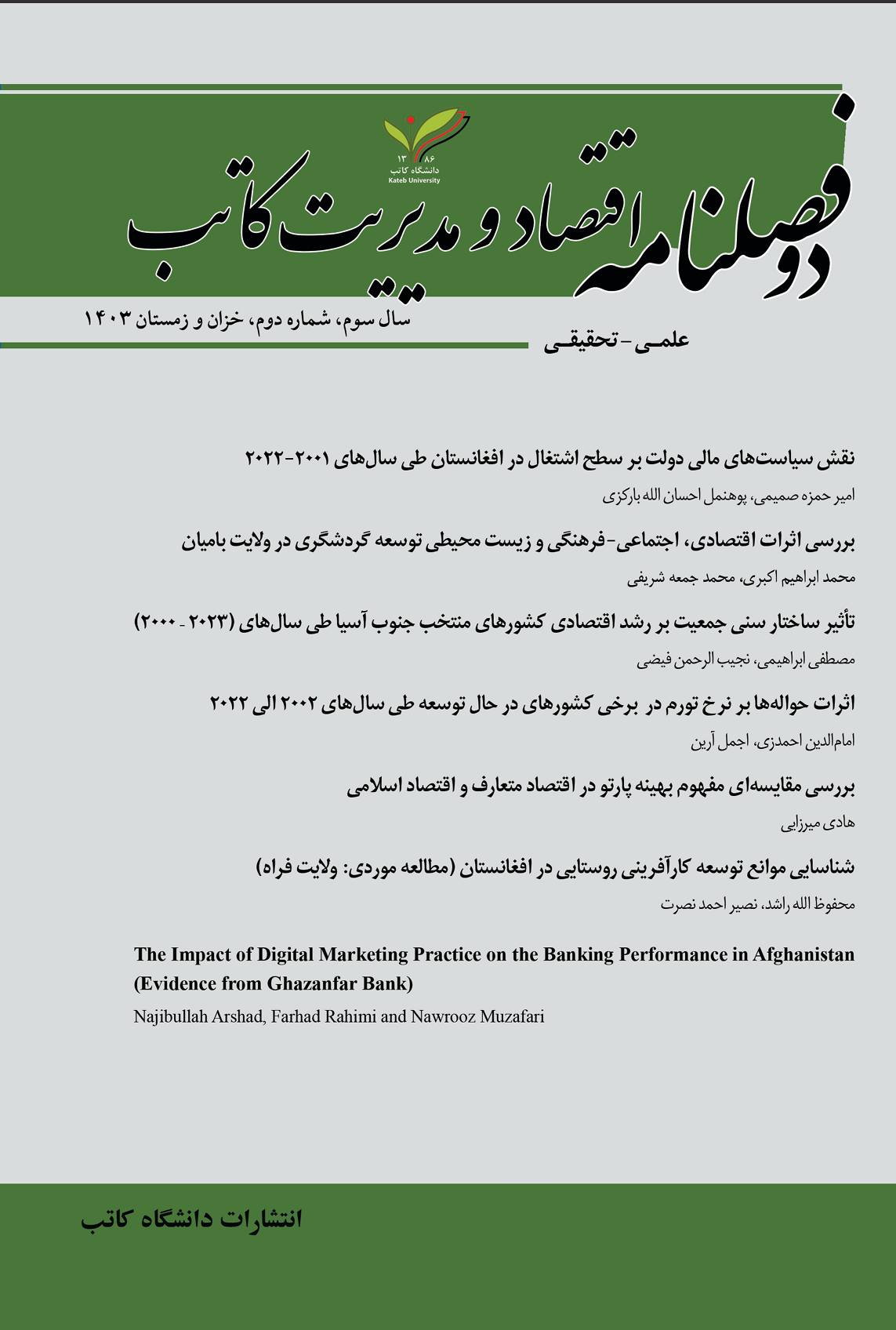
The Effects of Remittances on Inflation Rates in Selected Developing Countries (2002–2022)
Main Article Content
Abstract
This study examines the impact of financial remittances on inflation rates in selected developing countries over the period 2002 to 2022. Remittances, as a significant source of foreign income, play an effective role in improving household living standards and reducing poverty. However, these financial inflows may have complex effects on macroeconomic indicators, particularly inflation. The objective of this research is to explore the relationship between remittances and inflation. To achieve this, panel data from five selected countries [Afghanistan, Pakistan, Nepal, Sri Lanka, and India] were collected. The research methodology is based on an econometric model using the Generalized Least Squares (GLS) approach. Data were obtained from reputable international sources such as the World Bank, and unit root and cointegration tests were conducted to validate the models.The results show that government expenditures, nominal effective exchange rate, and money supply have a positive and significant impact on inflation, whereas remittances have no statistically significant effect on inflation. This finding indicates that in the studied countries, remittances do not play either an inflationary or deflationary role. Therefore, policymakers should focus on the effective management of fiscal and monetary policies, stabilization of the exchange rate, and directing foreign exchange resources towards productive investments. Additionally, strengthening economic infrastructure can help enhance readiness to deal with the potential impacts of remittances on inflation in the future. The findings may serve as a basis for further research in this field.
Keywords
Article Details
How to Cite
Similar Articles
- Hadi Mirzaie, A Comparative Study of the Concept of Pareto Optimality in Conventional and Islamic Economics , Kateb International Journal of Economics and Management: Vol. 3 No. 2 (1403): Valume 3, Issue 2, Aumtumn 2024 & Winter 2025
- Mahfoozullah Rashid, Nasir Ahmad Nusrat, Identifying Barriers to Rural Entrepreneurship Development in Afghanistan (A Case Study: Farah Province) , Kateb International Journal of Economics and Management: Vol. 3 No. 2 (1403): Valume 3, Issue 2, Aumtumn 2024 & Winter 2025
- Najibullah Arshad, Ahmadnawid Wahidi , Tamana Hussaini, The Relationship Between the Supervisory Role of Inspectors in the Supreme Audit Office and the Enhancement of Administrative Integrity in Afghanistan , Kateb International Journal of Economics and Management: Vol. 2 No. 2 (1402): Volume. 2, Issue. 2, َAutumn & Winter 2023-2024
- Mohammad Hakim Haider, Determinants of Vulnerability to Poverty in Afghanistan , Kateb International Journal of Economics and Management: Vol. 2 No. 1 (1402): Volume. 2, Issue. 1, Spring & Summer 2023
- Hassan Rohani, Ahmad Mohammadi, Hamida Haidari, Review of the relative advantage of agricultural product exports from Afghanistan (2005–2018) , Kateb International Journal of Economics and Management: Vol. 1 No. 1 (1401): Volume 1, Issue 1, Spring & Summer 2022
- Sayed Hadi Alimi, Musa Farooqi, The Impact of Government Health Expenditures on Child Mortality in Afghanistan During the Years (2002–2024) , Kateb International Journal of Economics and Management: Vol. 4 No. 1 (1404): Vol. 4, No. 1, Spring & Summer 2025
- Nawroaz Mozaffari, Mohammad Fahim Rahimi, Meta-Analysis of Factors Influencing Rural Entrepreneurship in Afghanistan , Kateb International Journal of Economics and Management: Vol. 4 No. 1 (1404): Vol. 4, No. 1, Spring & Summer 2025
- Ahmad Samir Enami, Ajmal Arian, Assessing the Impact of Liquidity on Bank Profitability: A Comparative Study of Public and Private Banks in Afghanistan , Kateb International Journal of Economics and Management: Vol. 4 No. 1 (1404): Vol. 4, No. 1, Spring & Summer 2025
You may also start an advanced similarity search for this article.